

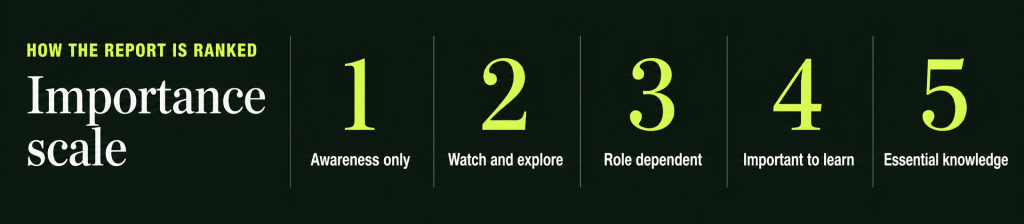
Five major trends are reshaping how websites are created, protected, experienced, delivered, and made available to everyone. This report ranks what web designers and developers should learn first.
AI, immersive experiences, and app-like delivery are expanding what websites can do. Cybersecurity, privacy, and accessibility determine whether people can trust and use those experiences. The strongest web professionals will continue learning new technology while making careful choices about user needs, safety, inclusion, performance, and long-term maintenance.
Artificial Intelligence
Ranked 5 of 5
Artificial intelligence is changing both how websites are built and what they can do. Developers can use AI-assisted tools to draft code, test interfaces, analyze data, personalize content, power chat experiences, and improve search. AI can speed up routine work, but its output still needs human review for accuracy, originality, security, bias, and accessibility. Web professionals also need to understand how automated agents may discover, interpret, and interact with web content.
Will it become a future standard?
Yes.
I believe AI-assisted development and AI-powered features will become standard parts of web work. The specific tools will change quickly, so the lasting skill will be knowing how to evaluate output, protect user data, write clear instructions, and decide when AI actually improves the experience. AI should support professional judgment rather than replace it.
Cybersecurity and Privacy
Ranked 5 of 5
Cybersecurity and privacy must be considered throughout the design and development process rather than added at the end. Modern sites need secure authentication, protected data, updated dependencies, careful permissions, safe form handling, and plans for responding to incidents. Privacy-focused design also includes collecting only necessary information, clearly explaining its purpose, obtaining meaningful consent, and giving users appropriate control over their data.
Will it become a future standard?
Yes.
Security and privacy are already fundamental expectations and will continue becoming stronger professional and legal standards. Every web developer should understand secure coding, data minimization, access control, software updates, and transparent consent. As websites connect with more services and AI systems, earning and maintaining user trust will become even more important.
Accessibility
Ranked 4 of 5
Accessible websites allow people with visual, auditory, physical, speech, cognitive, learning, and neurological disabilities to use web content and complete important tasks. Accessibility involves semantic HTML, keyboard navigation, sufficient color contrast, useful alternative text, visible focus indicators, understandable forms, captions, flexible text, and testing with assistive technology. It improves usability for many people beyond those who identify as disabled.
Will it become a future standard?
Yes.
Accessibility is a permanent web standard, not a temporary design style. Expectations will continue to grow as guidelines, testing tools, assistive technologies, and legal requirements evolve. Designers and developers should include accessibility from the first wireframe through content entry, coding, testing, and maintenance instead of treating it as a final checklist.
Progressive Web Apps
Ranked 4 of 5
Progressive Web Apps (PWAs) use web technologies to deliver experiences that can feel more like installed applications. A PWA can include a web app manifest, responsive layouts, secure HTTPS delivery, service workers, offline or low-connectivity support, background updates, and installation to a device’s home screen when supported. This approach can help organizations reach users across platforms without maintaining a completely separate application for every device.
Will it become a future standard?
Maybe.
I expect PWA capabilities to remain an important standard option, although not every website needs to behave like an app. They are especially valuable for frequently used services, field tools, e-commerce, event information, and audiences with unreliable connections. Developers should learn the core technologies and use them when offline access, installation, or dependable performance supports a real user need.
Augmented and Virtual Reality
Ranked 3 of 5
Augmented reality (AR) places digital information into a view of the physical world, while virtual reality (VR) creates a more fully immersive environment. On the web, WebXR provides interfaces for experiences that can work across supported headsets, mobile devices, sensors, and other hardware. Possible uses include virtual property tours, product previews, training simulations, museums, education, remote collaboration, and interactive storytelling.
Will it become a future standard?
Maybe.
AR and VR will become more common, but I do not expect them to replace traditional websites. They are likely to become a standard specialty for industries where space, scale, movement, or simulation communicates something that a flat screen cannot. General web developers should understand their possibilities and accessibility concerns, while specialists will need deeper 3D, performance, interaction, and device-testing skills.